News in 2026
|
 The first five parts of the Land
Administration Domain Model (LADM) Edition II have been published as ISO
and CEN standards. This is an important milestone in the development of
interoperable land administration systems.
The first five parts of the Land
Administration Domain Model (LADM) Edition II have been published as ISO
and CEN standards. This is an important milestone in the development of
interoperable land administration systems.
The second edition builds on the success of the first edition of LADM, which has been adopted or profiled in more than 50 countries. LADM Edition II is a major step forward, based on more than ten years of international experience, national implementations and research into a multi-part standard that supports land tenure, land value, land use and land development within an integrated digital ecosystem.
Further information about the first five parts of LADM Edition II can be found here:
The development of LADM Edition II was supported by the FIG Foundation with the 'FIG LADM Project - Finalisation of ISO Standards of LADM.
The process of revising and
expanding the scope of LADM began in 2017 based on the requirements of
national agencies, academic institutions, international organisations
and the UN-GGIM Expert Group on Land Administration and Management.
Between 2017 and 2025, a series of international workshops and expert
meetings were organised in the Netherlands, Croatia, Malaysia, Sweden
and Brazil. A new work item proposal (NWIP) was drawn up for each of the
five parts of LADM Edition II, and these proposals were submitted by FIG
to ISO TC/211.
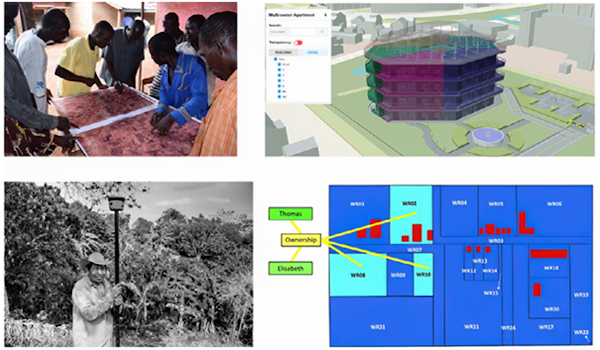
The LADM revision project was
supported between 2018 and 2023 by Kadaster Netherlands. Abdullah Kara
from Türkiye worked as a researcher at Delft University of Technology
together with Peter van Oosterom and Christiaan Lemmen. Between 2024 and
2025, the FIG Foundation provided support for the LADM revision process
for LADM Edition II parts 2, 4 and 5 until all parts were published as
international standards. Throughout this entire period, Delft University
of Technology and the University of Twente also provided support.
The revision project, initiated
under the leadership of FIG, has delivered a significantly expanded ISO
standard that responds directly to the evolving needs of land
administration community. The modular structure of LADM Edition II
allows countries and organisations to implement LADM components
separately or combined, always ensuring semantic consistency and
interoperability across institutional domains.
LADM Edition II improves
semantic modelling (e.g. with code lists) and implementation guidance
(to be done in Part 6 which has recently started in the OGC after
completion of conceptual models in part 1 to part 5), thereby providing
a solid foundation for digital land management ecosystems. The results
can contribute directly to international policy objectives, including
the UN Sustainable Development Goals. By expanding the scope from
traditional land registration to valuation, spatial planning and
maritime areas, LADM Edition II enables improved tenure security, fair
taxation, access to credit, disaster management, environmental
protection and more transparent land management.
The support of FIG and the FIG
Foundation was crucial in enabling sustainable international
cooperation, expert workshops and coordination between FIG Commissions 3
and 7 and the FIG Standards Network. This support ensured continuity of
work over several years and promoted the active involvement of experts
from different regions and disciplines. The successful completion of the
project demonstrates that the Foundation plays a crucial role in
promoting impactful, globally relevant standards for land management.
Authors: Assistant Professor Abdullah Kara, Professor Peter van
Oosterom, and Professor Christiaan Lemmen.
Published
26 January 2026